 The Hummingbird Hawkmoth has an amazing ability to choose suitable coloured roosting sites. This one chose Laburnum pods in my garden today and was very difficult to spot.
Thursday, 30 September 2010
Hummingbird Hawkmoth
The Hummingbird Hawkmoth has an amazing ability to choose suitable coloured roosting sites. This one chose Laburnum pods in my garden today and was very difficult to spot.
Monday, 20 September 2010
Designer Fly Agaric

 Amongst the many Fly Agarics at the Lodge today was this interesting 'designer' version.
Tuesday, 14 September 2010
Shaggy Inkcap (?) MVCP
 This fungi was near the path at Stewartby Lake at beginning of the climb up to the the hilly area near the lagoon corner if you approach from the sailing club side. I'm guessing it might be a Shaggy Inkcap purely because it was shaggy and inky but I've not looked it up so I would appreciate it if anyone would let me know what it actually is... Photo by Martin Green.
Saturday, 4 September 2010
Apple Mine
There were around 25 Vespula vulgaris excavating into this single apple at Mowsbury Hill LNR. Here's one making off with some pulp:

Photo by Keith Balmer

Photo by Keith Balmer
Chequers and Medlars
Two of our more unusual fruits can be seen at the moment at Mowsbury Hill LNR; Chequers on the Wild Service Tree:

and Medlars, which apparently need "bletting" before they can be used:

Photos by Keith Balmer

and Medlars, which apparently need "bletting" before they can be used:

Photos by Keith Balmer
Thursday, 2 September 2010


Grass Snake - West Wood
 This obliging Grass Snake posed between two fungi in West Wood before making a hasty retreat.
Tuesday, 31 August 2010
Caterpillar ID

Nearly stepped on this striking caterpillar outside the back door - any suggestions on identification please?
30-35 mm in length. Not quite right for Lime Hawk-moth?
Monday, 30 August 2010
Common Lizard - Stewartby Lake
 This Common Lizard was at the Stewartby Lake gullwatch this afternoon. It's the first one I can remember seeing at the lake for many years although I know they have been seen there by other people. Photo by Martin Green.
 Red-legged Shieldbug
A photogenically positioned Pentatoma rufipes dead centre of an angelica umbel at West Wood.

Photo by Keith Balmer

Photo by Keith Balmer
New to VC30 - Stigmella tiliae & Enteucha acetosae
Leafmining micro-moths added to the Bedfordshire (VC30) list in the last week were Stigmella tiliae and Enteucha acetosae.
Stigmella tiliae was found mining the leaves of a Lime tree in Lower Stondon on 23th August by Melissa Banthorpe and subsequently at Woburn Park, The Lodge RSPB Sandy and Ampthill Park by Melissa and Andy. All scans by Andy Banthorpe


Enteucha acetosae was found mining the leaves of Sheep's Sorrel at Ampthill Park on 29th August by Melissa and Andy.


Stigmella tiliae was found mining the leaves of a Lime tree in Lower Stondon on 23th August by Melissa Banthorpe and subsequently at Woburn Park, The Lodge RSPB Sandy and Ampthill Park by Melissa and Andy. All scans by Andy Banthorpe
Stigmella tiliae mine from Lower Stondon 23/08/10

Stigmella tiliae mine + larva from Ampthill Park 29/08/10

Enteucha acetosae was found mining the leaves of Sheep's Sorrel at Ampthill Park on 29th August by Melissa and Andy.


Sunday, 29 August 2010
Schizophrenic bramble
Most leaves on these two suckers of bramble at Old Warden Tunnel are pure yellow but a couple were exactly half green. Does anyone know if this aberration has a name?


Saturday, 28 August 2010
Stewartby Lake - sunrise
 There was an excellent sunrise at Stewartby Lake this morning, I haven't altered the colours on the photo. Unfortunately, I only had my long telephoto lens with me... Photo by Martin Green.
Sunday, 22 August 2010
Flying Wolf
I spotted this female Philanthus triangulum, the Bee Wolf, coming towards me at Sandy Smith NR and grabbed a few shots, but only this one was vaguely in focus:

Then she turned sideways towards her burrow and I was able to grab a few as she went past:

The honey bee she was carrying was then buried as food for her young. Here the burrow is being re-opened on her return, having concealed it with sand when she left:

Photos by Keith Balmer

Then she turned sideways towards her burrow and I was able to grab a few as she went past:

The honey bee she was carrying was then buried as food for her young. Here the burrow is being re-opened on her return, having concealed it with sand when she left:

Photos by Keith Balmer
Hunting flies
There was an abundance of flies feeding on mint at Sandy Smith NR, making it an ideal hunting ground for Mellinus arvensis wasps. It was interesting to watch them stalk their prey. This one got away:

but this one wasn't so lucky!

Here's a sequence of stalking,
stinging to paralyse

wrestling

shaking violently

and finally hugging

before eventually flying off with it to her nest.
Photos by Keith Balmer

but this one wasn't so lucky!

Here's a sequence of stalking,

stinging to paralyse

wrestling

shaking violently

and finally hugging

before eventually flying off with it to her nest.
Photos by Keith Balmer
Saturday, 14 August 2010
Small Ranunculus larvae
Below are two photos of the larvae of the macro-moth Small Ranunculus on Prickly Lettuce. The upper one was found on 14th August in Lower Stondon and the lower brown form found in Flitwick on 12th. Photos by Andy Banthorpe.


Tuesday, 10 August 2010
A female Common Emerald damselfly, at the 'Wall Brown' bridge at Rookery.
 A (presumably Common?) Lizard at Rookery.
 ...and a (again presumably Common?) Toad at College Wood
 A good day for reptiles and amphibians, not so good for butterflies, though I did see, but not photograph, a Wall Brown at Rookery, and I did manage to get some pics of the final resident Bedfordshire butterfly I hadn't photographed with my digital camera. I won't reveal the species, as it's too embarrassing.
 A (presumably Common?) Lizard at Rookery.
 ...and a (again presumably Common?) Toad at College Wood
 A good day for reptiles and amphibians, not so good for butterflies, though I did see, but not photograph, a Wall Brown at Rookery, and I did manage to get some pics of the final resident Bedfordshire butterfly I hadn't photographed with my digital camera. I won't reveal the species, as it's too embarrassing.
Monday, 9 August 2010
Red-tipped Clearwing
 Chicksands Wood 8/8/10 near southern monument - an unexpected bonus while watching the White-letter Hairstreaks.
Sunday, 8 August 2010
Blunham Lizard
A lizard on a fencepost at Blunham actually turned its head sideways for the photo, its best side presumably.

Shame about the out-of-focus blade of grass in the foreground that I didn't notice!
Photo by Keith Balmer

Shame about the out-of-focus blade of grass in the foreground that I didn't notice!
Photo by Keith Balmer
Saturday, 7 August 2010
Chicksands Wood
I first thought this was a bishop's mitre but it didn't seem right so took a few pics which enabled confirmation as Eurygaster testudinaria the Tortoise Shieldbug. Bernard Nau and Sheila Brooke confirmed the ID, adding that they had recently found nymphs but this was the first adult record for the county.

Nearby was this stunning fly which deserved photographing. Many thanks to Stephen Plummer and John O'Sullivan for identifying as a male Phasia hemiptera tachinid fly.

Photos by Keith Balmer

Nearby was this stunning fly which deserved photographing. Many thanks to Stephen Plummer and John O'Sullivan for identifying as a male Phasia hemiptera tachinid fly.

Photos by Keith Balmer
Humming-bird Hawk-moth larva
One of three larvae found at a site in north Beds this afternoon by Andy and myself - thanks to a tip-off from John Comont. Good to get a breeding record. Photo: Melissa Banthorpe


Friday, 6 August 2010


Sunday, 1 August 2010
Renhold Hedge
In a hedge north of Renhold was a Magpie laying on Blackthorn


and buff-tip larvae on an oak...

Pictures by Keith Balmer


and buff-tip larvae on an oak...

Pictures by Keith Balmer
Friday, 30 July 2010

Tuesday, 27 July 2010
Some butterflies from the weekend:
Red Admiral, Sharpenhoe Clappers, 24th July
 A couple of (the many) Chalkhill Blues flying at Sharpenhoe Clappers, 24th July

 Gatekeeper, King's Wood Heath & Reach , 24th July
 A a couple of Silver-washed underwings , King's Wood Heath & Reach , 24th July

 ...and some Brown Argus and brown female Common Blues from Octagon Farm, 25th July
 This is a Brown Argus, from the lack of spots on the forewing closer to the body than the elongated spot in the middle, and the 'colon' mark of the two spots near the middle of the forward edge of the hindwing.
 The same individual showing a little upperwing - note the lack of white crescents at the rear of the orange and black spots on the upperwings, I think this may be a Brown Argus feature.
 I think this is the same individual, taken a few seconds later when it had moved to a new flower. This probably makes it clearer that there are no spots on the inner forewing, though you can't see all of it.
 This on the other hand is a very brown female Common Blue (taken to be a Brown Argus when I photographed it). Note the spot on the under forewing closer to the body than the double spot, and the absence of two spots on the under hindwing making a colon.
 This is the same individual's upper side - note the blue on the body and hint of blue on the wing bases, despite the overall Brown Argus-like appearance. Note also the narrow white crescents behind the orange and black spots on the hindwings. I'm coming to the conclusion that these two species are more difficult to ID than I thought.
 Finally, a nice blue male Common Blue at College Wood on the same day - clearly a spot on the inner forewing and no colon mark on the hindwing.
Red Admiral, Sharpenhoe Clappers, 24th July
 A couple of (the many) Chalkhill Blues flying at Sharpenhoe Clappers, 24th July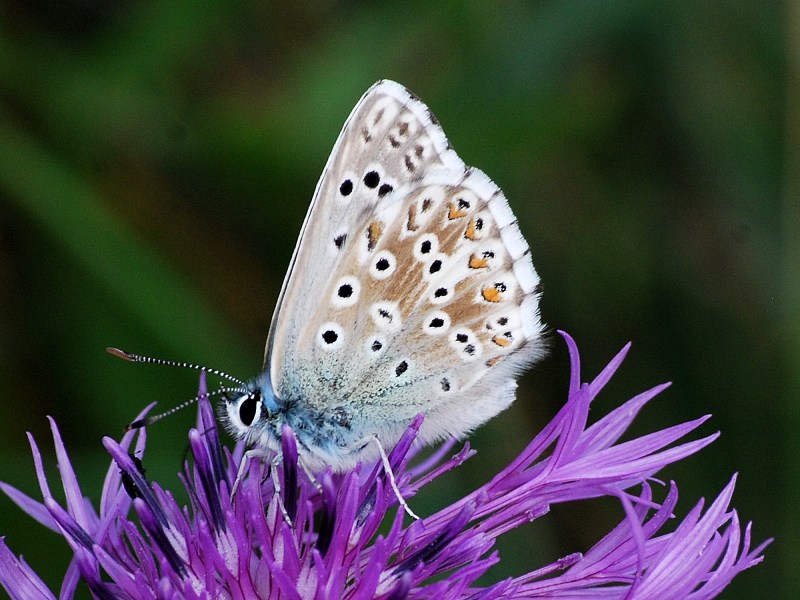
 Gatekeeper, King's Wood Heath & Reach , 24th July
 A a couple of Silver-washed underwings , King's Wood Heath & Reach , 24th July
 ...and some Brown Argus and brown female Common Blues from Octagon Farm, 25th July
 This is a Brown Argus, from the lack of spots on the forewing closer to the body than the elongated spot in the middle, and the 'colon' mark of the two spots near the middle of the forward edge of the hindwing.
 The same individual showing a little upperwing - note the lack of white crescents at the rear of the orange and black spots on the upperwings, I think this may be a Brown Argus feature.
 I think this is the same individual, taken a few seconds later when it had moved to a new flower. This probably makes it clearer that there are no spots on the inner forewing, though you can't see all of it.
 This on the other hand is a very brown female Common Blue (taken to be a Brown Argus when I photographed it). Note the spot on the under forewing closer to the body than the double spot, and the absence of two spots on the under hindwing making a colon.
 This is the same individual's upper side - note the blue on the body and hint of blue on the wing bases, despite the overall Brown Argus-like appearance. Note also the narrow white crescents behind the orange and black spots on the hindwings. I'm coming to the conclusion that these two species are more difficult to ID than I thought.
 Finally, a nice blue male Common Blue at College Wood on the same day - clearly a spot on the inner forewing and no colon mark on the hindwing.
Subscribe to:
Posts (Atom)